
Cooking Technique
How to Properly Rest Meat
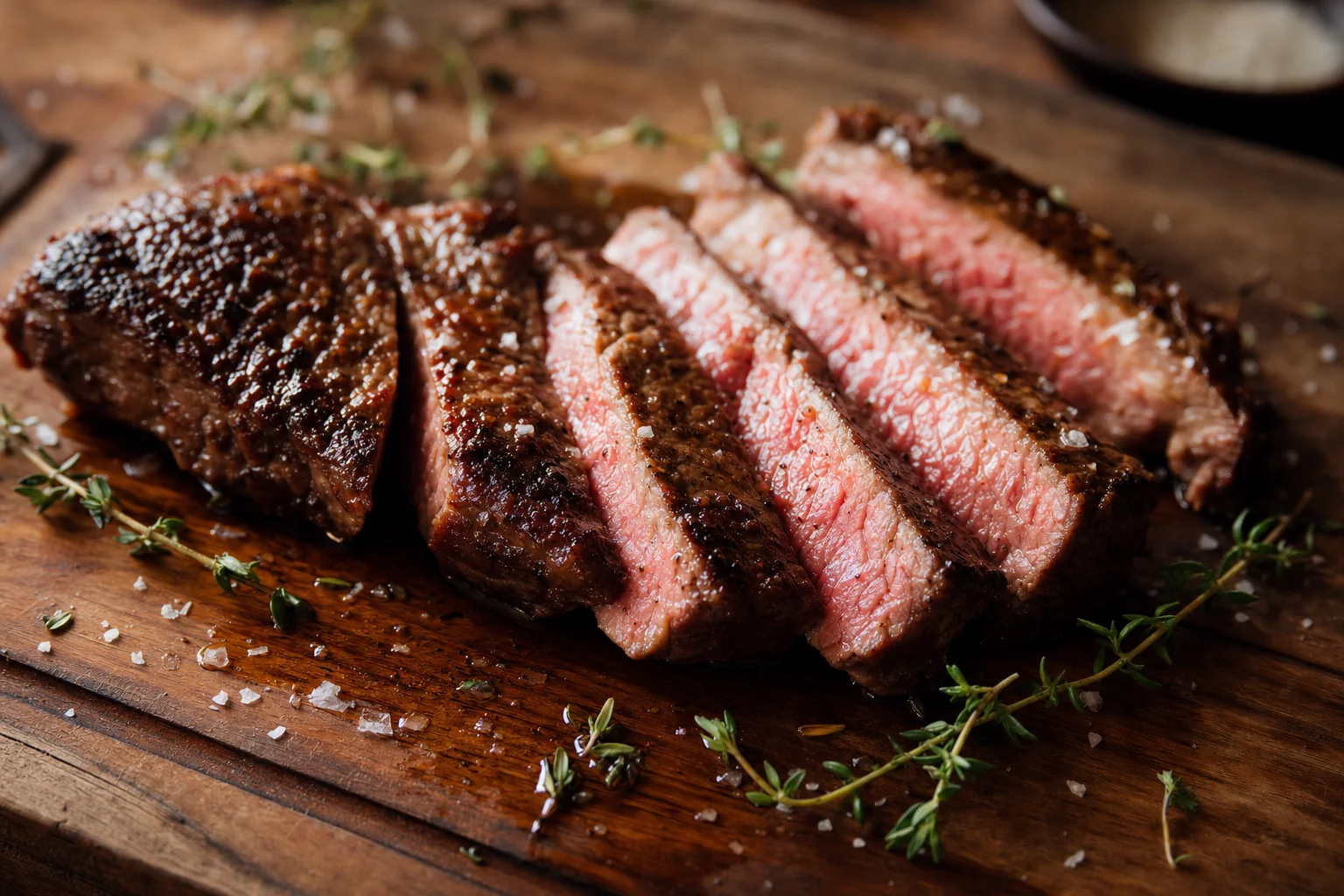
Cutting a steak straight off the heat sends its juices onto the cutting board, not into each bite. Five to eight minutes of patience redistributes all of that liquid back through the meat. It is not optional — it is the last step of cooking.
What Resting Does
Resting is the period between removing meat from a heat source and cutting into it. During that window, two important processes complete: juice redistribution and temperature equalization.
When meat cooks, the proteins in the outer muscle fibers contract under heat. This contraction squeezes moisture inward, toward the cooler center, creating a pressure gradient — a concentration of liquid in the middle and relatively dry outer layers. If you cut the meat immediately, you relieve that pressure suddenly, and the accumulated juices run out in a single rush onto the board. That liquid is not just water — it carries dissolved proteins, fat, and the flavor compounds built up during cooking.
During resting, the outer proteins gradually relax as the temperature equalizes. The pressure gradient dissipates slowly. By the time you cut, the juices have redistributed more evenly across the entire cross-section of the meat. Each slice retains its liquid rather than losing it to the board. The practical result is meat that tastes juicier throughout — not dry at the edges and pooling at the center.
The second process — temperature equalization — matters because the outer layers of meat are always hotter than the center when it comes off the heat. Resting allows the internal temperature to stabilize across the full thickness. This is also why the temperature continues to rise after the meat leaves the heat, a phenomenon called carryover cooking: the hot outer layers continue transferring heat inward for several minutes.
Why It Matters
In tests comparing identical cuts of the same steak — one cut immediately after cooking and one rested for seven minutes — the rested steak loses significantly less juice when sliced. The juice that stays in the meat rather than running onto the board is the difference between a steak that tastes juicy and one that tastes adequate.
Understanding carryover cooking also makes you a more accurate cook. A steak pulled at 130°F will reach 133 to 135°F during a seven-minute rest. If you wait until the thermometer reads your exact target temperature before pulling, the meat will overshoot it during resting. Pulling 3 to 5 degrees early and resting to temperature is the professional approach.
The technique applies to every protein — not just steaks. Whole roasted chickens, pork shoulder, lamb leg, and even thick-cut fish fillets benefit from a rest. The window is proportional to the size of the cut: a thin chicken breast needs only five minutes; a whole beef rib roast needs twenty to thirty.
Step-by-Step: How to Rest Meat Properly
-
Pull from heat 3–5°F before your target temperature.
Use an instant-read thermometer and pull the meat when it reads 3 to 5 degrees below your target internal temperature. For medium-rare steak (target 130–135°F), pull at 125–128°F. For a whole chicken (target 165°F), pull at 160°F. Carryover cooking will close the gap during resting. -
Transfer to a cutting board or warm plate.
Move the meat to a room-temperature wooden or plastic cutting board. Avoid placing it on a cold metal surface, which draws heat out more rapidly. If the board is very cold, run it briefly under hot water and dry it before using. A warm plate works well for small cuts. -
Leave individual steaks and chops uncovered.
Small cuts — steaks, lamb chops, pork chops, chicken pieces — should rest uncovered. Tenting them in foil traps steam, which softens the crust you spent time building. The temperature loss during a 5 to 8-minute rest is small — a steak that comes off at 125°F will be around 120°F after resting, which is still hot and within serving range. -
Loosely tent large roasts only.
A whole chicken, pork shoulder, or beef roast has enough mass that it needs 20 to 30 minutes of resting, during which heat loss becomes more significant. Drape a loose piece of foil over the top — not a tight seal — to slow the temperature drop without trapping steam. Loosely tented means the foil barely touches the surface, with air gaps around the edges. -
Time the rest correctly.
Use the resting period — do not stand over the meat watching it. This is the moment to build a pan sauce in the same pan, finish a side dish, or set the table. The timing guidelines below tell you how long each type of cut needs. -
Slice against the grain.
Before cutting, identify which direction the muscle fibers run — visible as long lines across the surface of the meat. Cut perpendicular to those lines. Slicing with the grain leaves long, chewy fibers intact in each bite; slicing against the grain shortens them, making even a tougher cut feel significantly more tender. -
Serve immediately after slicing.
Sliced meat loses temperature rapidly. Once you cut, plate and serve without delay. Do not slice and then let it sit while you finish other things — the juices will begin to run and the meat will cool.
Carryover calculator: Thin steaks (under 1 inch) gain about 3°F during resting. Standard steaks (1–1.5 inches) gain 4–5°F. Large roasts can gain 7–10°F. Pull earlier than your target accordingly.
Resting Times by Cut
| Cut | Rest time | Cover? |
|---|---|---|
| Thin steak (under 1 inch) | 4–5 minutes | No |
| Standard steak (1–1.5 inches) | 5–8 minutes | No |
| Thick steak or côte de bœuf (2+ inches) | 8–12 minutes | No |
| Pork chop | 5 minutes | No |
| Lamb chop | 5 minutes | No |
| Chicken breast | 5 minutes | No |
| Bone-in chicken pieces | 5–8 minutes | No |
| Whole roasted chicken | 15–20 minutes | Loose tent |
| Pork tenderloin | 8–10 minutes | No |
| Pork shoulder / beef roast | 20–30 minutes | Loose tent |
Common Mistakes
1. Not resting at all
Cutting immediately after cooking is the single most common avoidable mistake with meat. The visual of juice running freely across the board is a clear signal that the rest was skipped. It takes no equipment and no additional skill — just the patience to wait. See the guide on cutting meat too soon for the full breakdown.
2. Tenting small cuts
Wrapping a steak in foil "to keep it warm" defeats much of the purpose of the sear. The steam trapped under the foil softens and moistens the crust, turning a crackling exterior into a flaccid one. Small cuts lose very little temperature in a five-minute rest — the trade-off is not worth it.
3. Pulling at target temperature
Pulling at your target temperature and then resting means the meat overshoots. A steak pulled at exactly 130°F will reach 134–136°F during a seven-minute rest — firmly medium rather than medium-rare. Pull 3 to 5 degrees early for precise results.
4. Resting on a cold metal surface
A cold sheet pan or metal cutting board draws heat out of the meat from the bottom up, creating a temperature gradient that partially undoes the equalization resting is meant to achieve. Use a room-temperature wooden board or a warm ceramic plate.
Equipment Notes
A reliable instant-read thermometer is the most important piece of equipment for resting correctly. Without one, you cannot pull at the right moment, which means you are either over-relying on touch (which requires experience to calibrate) or guessing. A good thermometer reads in under 3 seconds and costs less than two bad steaks.
A wooden cutting board is preferable to metal for resting. It insulates rather than conducts, which means the board does not actively cool the meat from below. A warm ceramic plate works well for individual steaks when you want to serve directly from the resting vessel.
When Resting Matters Less
Very thin cuts — fish fillets, thin chicken cutlets pounded to under half an inch, sliced duck breast — have so little mass that the juice-redistribution effect is minimal and they cool to an unpleasant temperature during even a short rest. These are better served immediately. Braised meats are also largely exempt: the braising liquid has already penetrated the muscle fibers thoroughly, and the low-and-slow cook has relaxed the proteins in a way that high-heat cooking does not. A braised short rib does not need to rest the way a grilled ribeye does.
Recipes Where Resting Shines
- Pan-seared steak with butter baste — rest while building the pan sauce
- Whole roasted chicken — the most dramatic improvement from a proper rest
- Slow-roasted pork shoulder — 25 minutes of resting before pulling
- Reverse-sear ribeye — resting bridges the oven phase and the sear phase
- Grilled lamb leg — the large mass benefits enormously from a 20-minute rest
Technique notes in every recipe
NowCook recipes flag every resting step with the correct time and method for the cut — written by a working chef so you never have to guess. Start your 14-day free trial, no credit card required. $9/month after.
Frequently Asked Questions
Why does meat need to rest after cooking?
During cooking, heat drives moisture toward the center of the meat as the outer proteins contract and squeeze inward. When you cut immediately, that pressure is still active and the juices run out freely onto the board. Resting allows the outer proteins to relax, which lets the juices redistribute more evenly through the muscle fibers. The result is meat that is juicier throughout rather than dry at the edges and wet at the center.
How long should you rest a steak?
A 1-inch steak needs 5 to 8 minutes of resting. A thicker steak — 1.5 to 2 inches — benefits from 8 to 10 minutes. The general rule is to rest meat for roughly half the time it spent cooking, up to a practical maximum of about 30 minutes for large roasts.
Will the meat get cold while it rests?
Some temperature loss is inevitable, but less than most people expect. A steak pulled at 125°F will be around 118–122°F after a 7-minute rest — still hot and within a comfortable serving range. The carryover cooking during resting also continues to raise the internal temperature by 3 to 5 degrees in the first few minutes. Serving on a warm plate helps retain heat.
Should you cover meat while it rests?
For individual steaks and chops, no. Covering them traps steam and softens the crust. For large roasts and whole birds where heat loss is a real concern over a 20 to 30-minute rest, a loose foil tent slows temperature drop without the steaming problem of a tight wrap.
Does resting time change for different meats?
Yes. Beef steaks and lamb chops: 5 to 8 minutes. Pork chops: 5 minutes. Chicken pieces: 5 minutes. Whole roasted chicken: 15 to 20 minutes. Larger pork or beef roasts: 20 to 30 minutes. The principle is the same — larger cuts lose heat more slowly and need more time for the redistribution to complete — but the absolute times scale with mass.
Complete the sequence
Related mistake