
Cooking Technique
How to Make a Pan Sauce
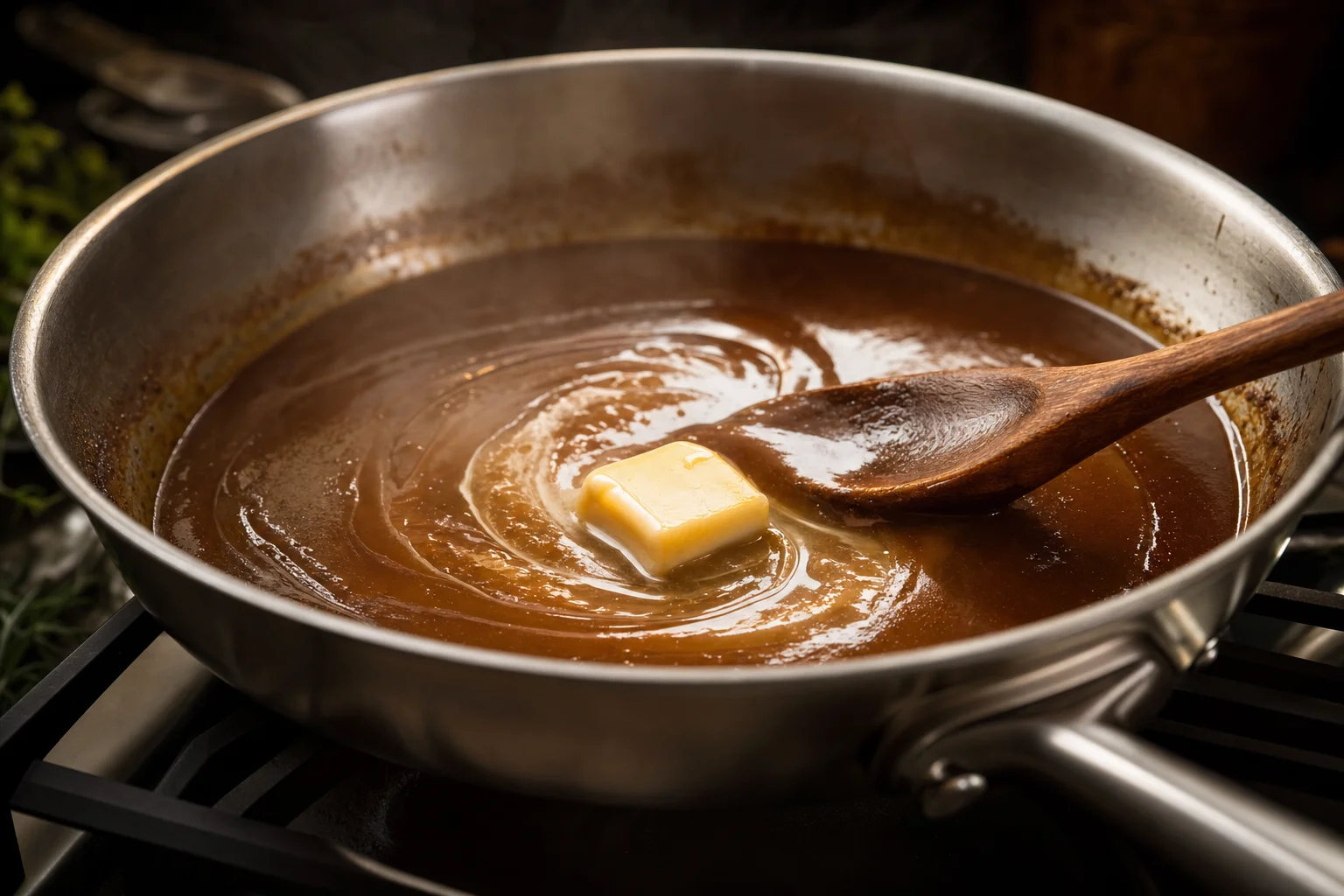
A pan sauce uses everything the searing step left behind — the fond, the fat, the flavor — and turns it into a glossy sauce in the same five minutes your meat is resting. Most home cooks skip it. Every restaurant kitchen uses it.
What a Pan Sauce Is
A pan sauce is a sauce built directly in the pan used to cook a protein, using the fond — the concentrated, browned residue on the pan surface — as its flavor foundation. By deglazing the pan with wine or stock, scraping up the fond, adding aromatics and more liquid, reducing, and finishing with cold butter, you produce a sauce that is fully customized to the protein you just cooked and tastes deeply savory in a way that pre-made sauces cannot replicate.
The technique is the standard finishing move in restaurant cooking for good reason: it requires no extra pot, takes four to six minutes (exactly the time your meat should be resting anyway), uses pantry staples, and produces a sauce whose flavor is uniquely tied to the specific batch of food you made. The fond from a duck breast pan sauce is not the same as the fond from a pork chop pan sauce — and the finished sauces reflect that distinction completely.
Structurally, a pan sauce has four stages: fond (built during searing), deglaze (liquid added to dissolve it), reduction (concentrating the dissolved flavor), and finish (fat added off the heat to give body and sheen). Each stage builds on the last.
Why It Matters
Pan sauces close the gap between home cooking and restaurant cooking more quickly than almost any other single technique. A well-made pan sauce elevates an ordinary seared chicken breast or pork chop to something that tastes considered and complete. Without a sauce, seared protein, however well-executed, often feels like it is missing a component.
There is also a practical benefit: the pan sauce uses the fond that would otherwise require scrubbing off. Every bit of flavor generated during the searing step ends up on the plate rather than going down the drain with the washing-up water.
The technique scales with your skill. A basic pan sauce — deglaze with stock, reduce, finish with butter — is achievable after a few attempts. A more complex version adds a wine deglaze, minced shallots, fresh herbs, and a cream or mustard finish, and takes only two or three more minutes. The same structural logic applies to both.
Step-by-Step: How to Make a Pan Sauce
-
Remove the protein and evaluate the pan.
Transfer the seared protein to a cutting board to rest. Look at the pan: dark brown fond with clear oil is ideal. If there is a large amount of fat in the pan, tip it and spoon out the excess, leaving a thin film — about 1 tablespoon. Excess fat produces a greasy rather than glossy sauce. -
Sauté aromatics in the hot pan.
Add 1 to 2 minced shallots or 2 cloves of sliced garlic directly to the hot pan over medium heat. Cook for 60 to 90 seconds, stirring, until softened. The aromatics pick up the fond from the pan surface and add the beginning of a flavor base. This step can be skipped for a simpler sauce, but it adds depth. -
Deglaze with wine or stock.
Add 1/4 cup of wine (white for chicken or pork, red for beef or lamb) or stock to the pan and immediately scrape the bottom with a wooden spoon or flat spatula. The vigorous scraping dissolves the fond into the liquid. Let the liquid reduce until it is nearly dry — about 60 seconds of active boiling. This step is covered in detail in the guide on how to deglaze a pan. -
Add stock and aromatics, then reduce.
Add 1/2 cup of stock and any herbs — a sprig of thyme, rosemary, or tarragon — and increase the heat to medium-high. Let the sauce reduce for 2 to 3 minutes, stirring occasionally, until it lightly coats the back of a spoon. Remove and discard whole herb sprigs. -
Finish with cold butter off the heat.
Remove the pan from the heat entirely. Add 2 tablespoons of cold butter, cut into small cubes, and swirl the pan continuously — the swirling motion emulsifies the butter into the sauce, giving it body and a glossy sheen. This technique is called monter au beurre (mounting with butter) in French cooking. Do not let the pan return to high heat or the emulsion will break. -
Season, strain if needed, and pour.
Taste the sauce and adjust seasoning — a pinch of salt and a drop of lemon juice or a splash of wine can sharpen a flat sauce. Strain through a fine-mesh sieve for a fully smooth result, or leave as-is. Pour immediately over the rested protein.
Timing note: The entire pan sauce from deglaze to plate should take 4 to 6 minutes — exactly the time a steak or pork chop should rest before cutting. Start the sauce the moment the protein comes off the heat.
Variations by Protein
Chicken: White wine deglaze, chicken stock, thyme, finished with Dijon mustard stirred in with the butter.
Steak: Red wine or cognac deglaze, beef stock, fresh thyme, finished with cold butter and optional horseradish.
Pork: Apple cider deglaze, chicken stock, fresh sage, finished with cold butter and a pinch of brown sugar.
Duck: Orange juice and a splash of brandy deglaze, chicken stock, star anise or thyme, finished with cold butter and a touch of honey.
Fish (salmon, halibut): White wine deglaze, fish or vegetable stock, capers, finished with cold butter and fresh dill or parsley.
Common Mistakes
1. Too much fat left in the pan
A film of fat is necessary to sauté the aromatics, but a puddle of fat produces a greasy sauce that will not emulsify properly with butter. After removing the protein, tip the pan and spoon off all but about a tablespoon of fat before building the sauce.
2. Not reducing the wine enough
Adding stock before the wine has reduced to near-dryness leaves a raw wine flavor in the finished sauce. Let the wine reduce until it is almost gone — the pan should look nearly dry — before adding stock.
3. Adding butter to a hot pan
Butter added to a pan that is still over high heat separates immediately into greasy fat rather than emulsifying into the sauce. Always remove the pan from heat before adding the finishing butter, or reduce to the lowest possible heat.
4. Not tasting before serving
A pan sauce that tastes close but flat usually needs a small amount of acid — a drop of lemon juice or a splash of wine — or slightly more salt. Taste it on a spoon, then taste it on a bite of the protein it will accompany. Adjust from there.
Equipment Notes
Stainless steel is the best choice for pan sauces: the light-colored interior shows the fond clearly, and the pan releases cleanly when deglazing. Cast iron works but requires careful attention during the reduction phase as it holds heat so aggressively. A nonstick pan produces minimal fond and is not recommended for this technique.
When NOT to Use This Technique
Skip a pan sauce when the fond is burnt rather than browned (it will make the sauce bitter), when you are cooking something that leaves no fond (poached or steamed proteins), or when the dish's flavor profile is built around a separate sauce that would conflict with the pan flavors. Some dishes are complete without sauce — seared fish with just a lemon squeeze, a simple pan-roasted vegetable — and adding a pan sauce can overcomplicate them.
Recipes Where Pan Sauce Shines
- Pan-seared steak with butter baste — build the sauce from the same pan
- Chicken thighs with white wine and tarragon pan sauce
- Pork chops with apple and sage — a classic fall variation
- See also: how to sear meat properly and how to deglaze a pan
Recipes with built-in technique notes
NowCook recipes include chef-written technique notes — including pan sauce steps — integrated directly into the recipe flow. Start your 14-day free trial, no credit card required. $9/month after.
Frequently Asked Questions
What makes a pan sauce different from a regular sauce?
A pan sauce is built in the same pan used to cook the protein, using the fond as its flavor base. This creates a sauce that is uniquely suited to the protein it accompanies and has depth that a sauce made in a separate pot cannot easily replicate. A complete pan sauce takes 4 to 6 minutes.
Can I make a pan sauce without wine?
Yes. Stock (chicken, beef, or vegetable) deglazes just as effectively as wine. Cider, verjuice, and non-alcoholic alternatives also work. Water will deglaze the fond and make a serviceable sauce, though it adds no flavor of its own.
Why is my pan sauce greasy?
A greasy pan sauce usually means too much fat was left in the pan before building the sauce, or the butter was added to a pan that was too hot and separated rather than emulsified. Pour off all but about 1 tablespoon of fat before deglazing. Mount with butter off the heat.
How do I thicken a pan sauce that is too thin?
Continue simmering — reduction is the cleanest method. If you need to thicken faster, dissolve 1 teaspoon of cornstarch in 1 tablespoon of cold water and stir it into the simmering sauce. Cold butter added off the heat also adds body. See the guide to thickening a watery sauce for more options.
What proteins work best for pan sauces?
Any seared protein that leaves a brown fond: steak, pork chops, chicken thighs and breasts, duck breast, lamb chops, and firm fish like salmon or halibut. The richer the fond, the deeper the sauce. Lean proteins like chicken breast leave a lighter fond than fattier cuts like duck breast.
Required techniques
Troubleshoot