
Cooking Technique
How to Build a Flavor Base: Mirepoix, Sofrito & the Trinity
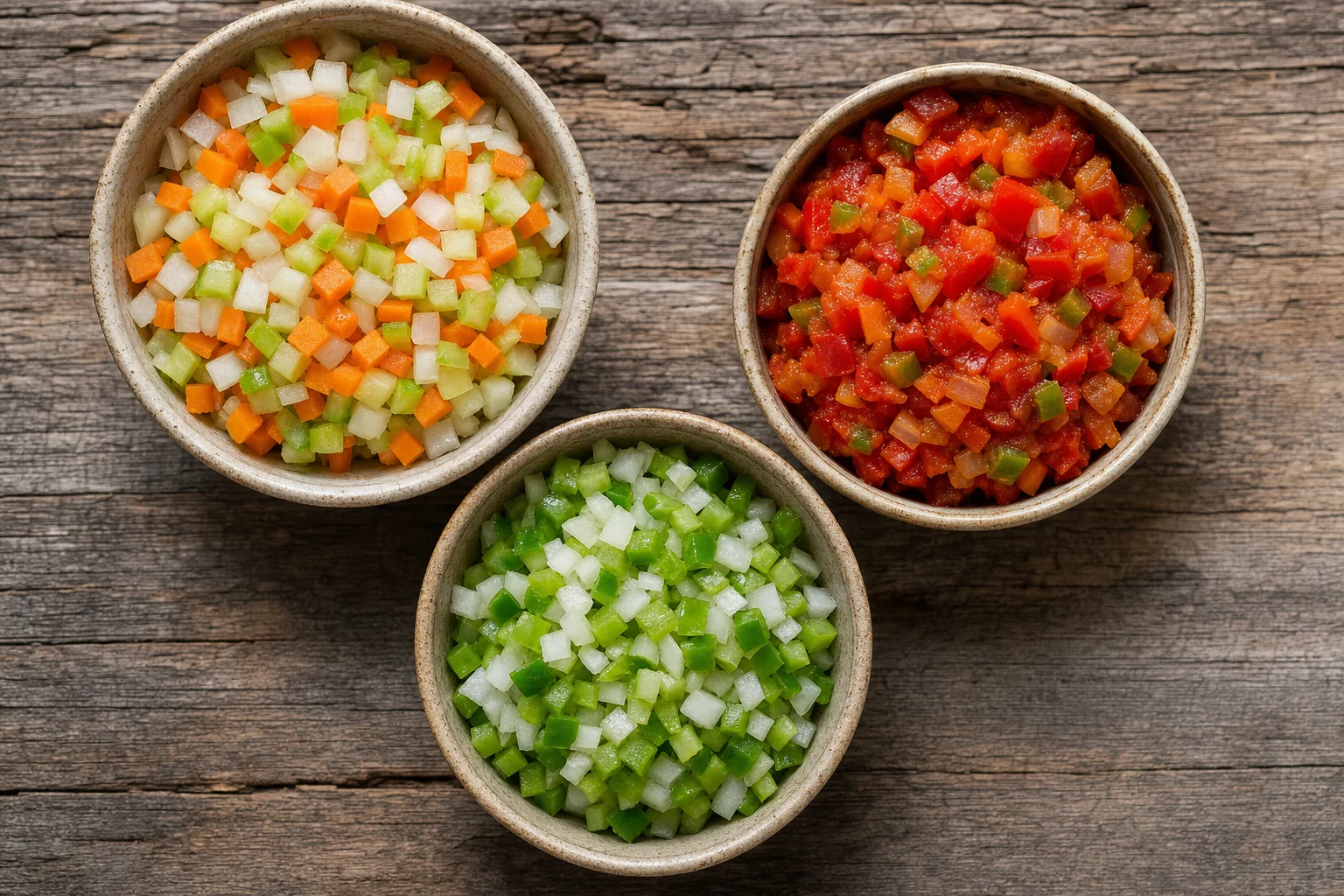
Three culinary traditions separated by oceans, sharing one idea: start every dish the same way. Dice aromatics, cook them slowly in fat, and build everything on top. The technique takes fifteen minutes. The effect lasts through the whole pot.
What a Flavor Base Is
A flavor base is a mixture of aromatic vegetables cooked slowly in fat at the very beginning of a recipe, before any liquid, protein, or other ingredients are added. The vegetables soften, their sugars concentrate, their raw sharpness mellows, and their flavor compounds dissolve into the fat. Everything added afterward cooks in — and is seasoned by — that aromatic foundation.
It is one of the oldest and most universal techniques in cooking. The specific vegetables change by region and tradition, but the logic is identical across French, Spanish, Latin American, Creole, Cajun, and many other cooking traditions: aromatics first, everything else second. This is not coincidence — it is a discovery that every culinary tradition made independently because the results are so consistently better.
The three most commonly referenced flavor bases in Western cooking are mirepoix (French), sofrito (Spanish and Latin American), and the holy trinity (Cajun and Creole). Understanding all three — what they share, how they differ, and when to reach for each — gives a cook fluency across a wide range of dishes and cuisines.
The Three Traditions: A Comparison
Mirepoix
French culinary tradition
- Onion (50%)
- Carrot (25%)
- Celery (25%)
- Fat: butter or oil
- Garlic: optional
Sofrito
Spanish & Latin American
- Onion
- Garlic
- Tomatoes
- Bell pepper
- Fat: olive oil
The Trinity
Cajun & Creole
- Onion (50%)
- Celery (25%)
- Green bell pepper (25%)
- Fat: oil or butter
- Garlic: often added
Mirepoix
Mirepoix is the foundation of French classical cooking — stocks, braises, soups, sauces, and almost every long-cooked preparation in the French canon begins with it. The classic ratio is two parts onion to one part carrot to one part celery, measured by weight. Onion provides the primary savory-sweet base; carrot adds gentle sweetness and color; celery adds a slightly bitter, vegetal depth that keeps the base from becoming too sweet.
The fat is typically butter or a combination of butter and oil. The vegetables are cooked over medium-low heat — sweated, not browned — until fully softened and translucent, which takes 10 to 15 minutes. This is called a "white" or blonde mirepoix. A pinçage or "brown" mirepoix, where the vegetables are cooked until lightly golden, is used for darker stocks and braises where a richer flavor is wanted.
Sofrito
Sofrito is the aromatic base used throughout Spain, Portugal, and across Latin America, with significant variation between countries and regions. The Spanish version typically includes onion, garlic, tomatoes, and sometimes bell pepper, all cooked slowly in olive oil until the tomatoes have broken down completely and the mixture is thick, fragrant, and deeply colored. The Cuban, Puerto Rican, and Dominican sofrito (also called recaíto when made with recao/culantro) adds cilantro, ají dulce peppers, and sometimes cumin or annatto.
Unlike mirepoix, sofrito often includes tomatoes as a primary component, which means it cooks longer — 15 to 20 minutes — to cook out the raw tomato flavor and concentrate the mixture. The finished sofrito is thick and jammy, not wet. It is a flavor paste as much as a cooked vegetable mixture.
The Cajun and Creole Trinity
The trinity — onion, celery, and green bell pepper — is the aromatic base of Louisiana cooking, appearing in gumbo, jambalaya, étouffée, red beans and rice, and countless other dishes. The name is informal but widely used in Louisiana home kitchens and professional ones alike. It replaces the carrot of French mirepoix with green bell pepper, which has a sharper, slightly bitter flavor note that suits the bold, assertive spicing of Cajun and Creole cooking better than the sweetness of carrot.
The trinity is typically cooked in whatever fat the dish calls for — lard, butter, or oil — and is often cooked longer than a French mirepoix, sometimes until lightly golden. Garlic is almost always added after the trinity has softened, giving the preparation the informal name "the trinity and the pope."
Why It Matters
A dish built on a proper flavor base has depth that a dish without one simply cannot replicate. The difference is not subtle: a soup started with softened mirepoix tastes like it cooked for hours even after a short simmer; the same soup started with raw vegetables added directly to the broth tastes thin and under-developed until considerably more time has passed.
The flavor base does something specific: it creates a dissolved aromatic foundation in the fat that every subsequent ingredient is introduced to. When stock, wine, or water is added to a pot containing a cooked mirepoix, the liquid immediately picks up the complex, already-developed flavor of the softened aromatics. Compare this to adding vegetables raw to a liquid, where they must first leach their flavor through direct simmering — a slower, less complete process.
Understanding flavor bases also makes improvised cooking more reliable. Once a cook internalizes the idea that almost any savory dish benefits from starting with softened aromatics, the technique applies to weeknight improvisation — a pasta, a quick braise, a bean dish, a grain bowl sauce — without needing a recipe to prescribe it.
Step-by-Step: How to Build a Flavor Base
-
Cut vegetables to uniform size.
Dice all aromatics to a consistent small dice — roughly 1/4 inch. Uniformity matters because pieces of different sizes cook at different rates: small pieces burn while large ones remain raw. For mirepoix, use the 2:1:1 ratio: 1 cup diced onion, 1/2 cup diced carrot, 1/2 cup diced celery as a baseline for a dish that serves 4. -
Heat fat in a heavy pot over medium-low heat.
Add 2 to 3 tablespoons of your chosen fat to a heavy-bottomed pot or Dutch oven. For mirepoix: butter or butter-oil blend. For sofrito: olive oil. For the trinity: oil, butter, or lard. Heat until the fat is hot enough to sizzle when a piece of onion is dropped in — but not so hot that it immediately colors. -
Add the aromatics with a pinch of salt.
Add all the vegetables at once and immediately add a generous pinch of salt. The salt draws moisture from the vegetables via osmosis, which speeds the softening process and inhibits burning. Stir immediately to coat every piece with fat. -
Sweat over medium-low heat for 10–15 minutes.
Cook slowly, stirring every 2 to 3 minutes, until the vegetables are completely softened and translucent — no crunch, no raw taste. They should smell sweet and savory, not sharp. If they begin to brown, reduce the heat and add a tablespoon of water to the pot and stir. -
Add garlic and other aromatics last.
Garlic burns easily and becomes bitter if overcooked. Add it after the base vegetables are fully softened — about a minute before you plan to move to the next stage. Bay leaves, thyme sprigs, and tomato paste can also be added at this stage, cooking the tomato paste out for 1 to 2 minutes until it deepens in color. -
Build the dish on top.
With the base complete, add the next layer: deglaze with wine, add stock or water, add protein or legumes, or proceed with whatever the recipe calls for. The base is the foundation — every ingredient added afterward cooks in its flavor. See the guide on blooming spices for how to combine these two techniques for curries, stews, and braises.
Sweating vs. caramelizing: For most applications, the vegetables should be translucent and soft but not browned. Once they start coloring, the flavor profile changes from sweet and mellow to roasted and savory. Both are useful — but they are different flavor bases for different dishes. Do not let them brown by accident if you want a delicate result.
Common Mistakes
1. Heat too high
The most common flavor base mistake is cooking over heat that is too high. The vegetables color before they have time to soften fully, and the resulting base is unevenly cooked — crisp and browned in spots, still raw in others. Medium-low is the right heat. If you hear aggressive sizzling, turn it down.
2. Not cutting uniformly
Uneven dicing means some pieces are done while others are still raw. The solution is simply consistent knife work — all pieces roughly the same size. Professional cooks are taught to dice aromatics uniformly not as an aesthetic exercise but because it directly affects the outcome.
3. Rushing the process
Ten to fifteen minutes feels like a long time when you are hungry and trying to get dinner on the table. Rushing the flavor base by turning up the heat and cutting the cooking time to five minutes produces aromatics that are partially cooked and still sharp-tasting. The base is the single most important step of the dish — it deserves its full time.
4. Adding garlic too early
Garlic burns in about 30 seconds in hot fat, and burned garlic is bitter and acrid. It should always go in after the other aromatics have mostly softened and the pan has cooled slightly from adding them. Add garlic, stir, and move to the next step within 60 to 90 seconds.
Equipment Notes
A heavy-bottomed pot or Dutch oven distributes heat evenly and prevents hot spots that burn vegetables before they soften. Enameled cast iron is excellent — it holds heat evenly, is easy to clean, and goes from stovetop to oven without issue. A thick-bottomed stainless pot also works well. A thin aluminum pot will develop hot spots that brown the vegetables unevenly, requiring more active stirring.
When to Use Each Tradition
- Mirepoix when cooking French or European dishes: soups, stocks, braises, white sauces, roasted vegetables, and any dish where you want a neutral, sweet-savory foundation.
- Sofrito when cooking Spanish, Italian (soffritto), Latin American, or any dish where tomato is a primary flavor and you want a deeper, more complex base.
- Trinity when cooking Cajun, Creole, or any dish that wants a slightly sharper, more assertive aromatic base — gumbo, jambalaya, red beans, dirty rice.
Recipes Where a Flavor Base Shines
- Turkish red lentil soup — sweated onion and garlic is the backbone
- White bean shakshuka — sofrito-style base of onion, garlic, and pepper under the eggs
- Classic French onion soup — white mirepoix as the starting point
- Chicken and sausage gumbo — trinity is the entire flavor foundation
- Any braise: the flavor base is always the first thing in the pot
Know your technique before you open the fridge
NowCook builds chef-calibrated recipes from the ingredients already in your kitchen — with technique notes explaining every foundational step, including the flavor base. Start your 14-day free trial, no credit card required. $9/month after.
Frequently Asked Questions
What is the difference between mirepoix, sofrito, and the Cajun trinity?
All three are aromatic vegetable bases cooked in fat at the start of a dish — the concept is identical, but the vegetables differ by culinary tradition. Mirepoix (French) uses onion, carrot, and celery in a 2:1:1 ratio by weight, cooked in butter. Sofrito (Spanish and Latin American) replaces carrot with bell pepper and adds tomatoes and garlic, cooked in olive oil. The Cajun and Creole trinity replaces carrot with green bell pepper — onion, celery, and green bell pepper — cooked in whatever fat suits the dish.
What is the correct ratio for mirepoix?
The classic French ratio is 2 parts onion to 1 part carrot to 1 part celery, measured by weight. For a medium pot of soup or stew, a practical starting point is 1 cup diced onion, 1/2 cup diced carrot, and 1/2 cup diced celery. This ratio is a starting point, not a rule — adjusting for more carrot (sweeter) or more celery (more savory) is entirely appropriate.
Should a flavor base brown or stay pale?
For most applications, a flavor base should soften and become translucent but not brown. Browning produces a more intense flavor that suits some dishes but overwhelms delicate broths, white sauces, and light soups. The standard instruction is to sweat the vegetables — cook slowly in fat until soft and sweet — not sauté or caramelize them.
Can you make a flavor base ahead of time?
Yes. A cooked mirepoix, sofrito, or trinity keeps in the refrigerator for up to four days and freezes for up to three months. Making a large batch and freezing in portioned containers is one of the most practical things a home cook can do to cut prep time on weeknights.
What does sweating vegetables mean?
Sweating is cooking vegetables in fat over low to medium-low heat until they soften and become translucent, releasing their moisture as steam without browning. Sweated vegetables are soft, sweet, and fragrant — their raw sharpness has been cooked out. The key conditions are: low heat, frequent stirring to prevent browning, and enough time — typically 10 to 15 minutes.
Pair with these techniques
Recipes that start here