
Cooking Technique
How to Temper Eggs
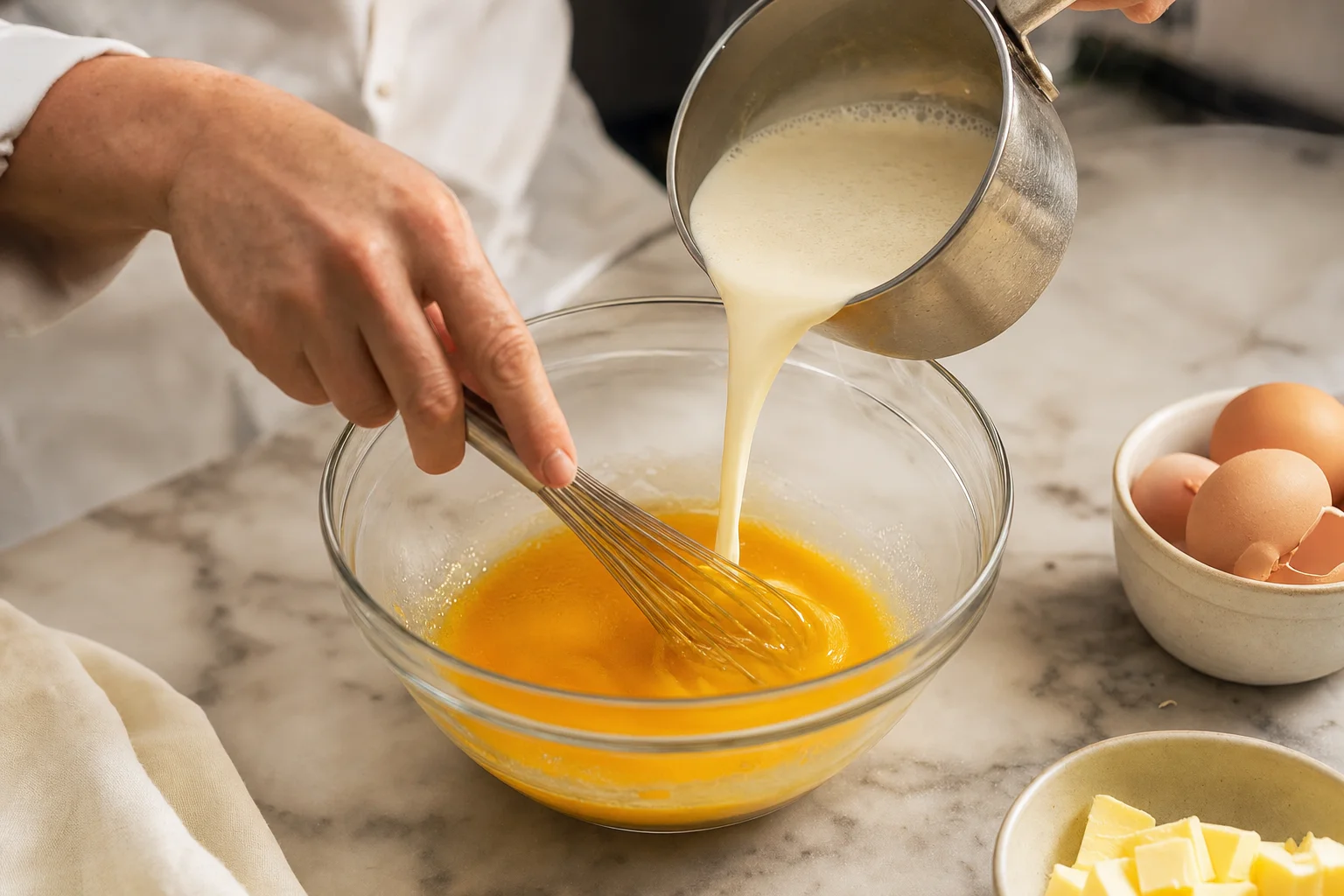
Eggs added directly to hot liquid scramble immediately. Tempered eggs — those brought up to temperature gradually — become the silky thickener behind custards, carbonara, and hollandaise. The technique is patient, not complicated.
What Tempering Is
Tempering is the process of gradually raising the temperature of a cold or room-temperature ingredient — usually eggs or egg yolks — by slowly introducing small amounts of a hot liquid before the eggs enter the full hot mixture. The goal is to raise the egg's temperature incrementally so it never crosses the coagulation threshold suddenly, which is what causes scrambling.
Egg proteins begin to coagulate — that is, change from a fluid to a set structure — at temperatures above roughly 144°F for whites and 149°F for yolks. When cold eggs hit liquid at 180°F or higher, the temperature differential causes immediate, irreversible coagulation: scrambled eggs. Tempering bridges that gap by slowly acclimating the eggs to the heat so they can enter the hot mixture still fluid, ready to thicken gently rather than scramble immediately.
The result, when done correctly, is a silky, uniform mixture where the egg proteins have unfolded slightly and dispersed evenly through the liquid — creating a thickened, creamy texture without any curdled bits.
Why It Matters
Tempering is the gatekeeper technique for an entire category of cooking. Without it, custards become grainy, carbonara becomes scrambled eggs with pasta, and hollandaise curdles. With it, these dishes have the smooth, unified texture that makes them so satisfying.
Beyond specific applications, understanding tempering teaches something important about egg chemistry: eggs are not simply cooked — they are controlled. The difference between a silky crème anglaise and a scrambled mess is often a matter of 10 to 15 degrees, managed carefully over 90 seconds.
It is also a transferable skill. Once you understand the logic of gradual temperature introduction, you apply it instinctively whenever cold and hot ingredients need to combine — beyond eggs, this same principle applies to incorporating cold cream into hot chocolate, or cold dairy into a hot soup base.
Step-by-Step: How to Temper Eggs
-
Have the eggs at room temperature if possible.
Pull eggs from the refrigerator 20 to 30 minutes before tempering. Room-temperature eggs have a smaller temperature differential with the hot liquid, which provides more margin for error. This step is helpful but not strictly required for success. -
Whisk the eggs until smooth and combined.
In a medium bowl, whisk eggs or yolks with any sugar, cheese, or starch called for in the recipe until the mixture is uniform. Lumps in the egg mixture temper unevenly. For custards, whisk yolks and sugar until slightly pale; for carbonara, whisk yolks with Parmesan and black pepper until combined. -
Add a small amount of hot liquid while whisking.
The first addition should be modest — 2 to 3 tablespoons of the hot liquid, added in a thin stream while whisking constantly. This is the most critical moment. Too much hot liquid too quickly can cook the eggs even at this stage. Whisk vigorously as you pour. -
Continue adding hot liquid in progressively larger amounts.
After the first addition, add a few more tablespoons, then a quarter cup, then a half cup — each time whisking after adding. By the time you have incorporated about half of the hot liquid, the egg mixture is warm enough to be safely added back to the pot. -
Return the mixture to the pot over low heat.
Pour the tempered egg mixture back into the pot, stirring constantly. Keep the burner on low or remove the pot from the heat entirely. Continue stirring until the mixture thickens to the desired consistency. For custards, it should coat the back of a spoon; for carbonara, it should cling to pasta in a creamy glaze. -
Strain if needed.
Pass the finished sauce or custard through a fine-mesh strainer into a clean container. Even a careful temper can leave tiny cooked egg particles. Straining removes them and guarantees a smooth, professional result.
The spoon test: For custard-based sauces, the mixture is done when it coats the back of a spoon and holds a line when you draw your finger through it. Do not cook further — overcooked custard will scramble even after successful tempering.
Common Mistakes
1. Adding the first amount of hot liquid too quickly
The first ladle is the most dangerous moment. Even a small amount added too fast can cook the eggs if it goes in all at once. Start with a thin stream — less than you think you need — and whisk as it goes in. After the first successful addition, subsequent additions can be larger.
2. Stopping whisking mid-pour
The moment you stop whisking during a hot liquid addition, the heat concentrates on the eggs nearest the liquid. Whisking disperses the heat throughout the egg mixture. Keep going throughout.
3. Returning the mixture to high heat
Successfully tempered eggs added back to a pot on high heat will scramble anyway. Always reduce to low or medium-low before adding the tempered mixture. The eggs are warm enough to continue thickening slowly; they do not need high heat.
4. Skipping the strain
Even a well-executed temper often leaves a few very small cooked egg flecks. These are invisible in a finished sauce but visible and unpleasant in a clear custard. Straining takes 30 seconds and removes any doubt.
Equipment Notes
A whisk is essential — a spoon does not create enough agitation to distribute heat rapidly enough through the eggs. A stainless-steel bowl is ideal because it conducts heat evenly. A ladle or measuring cup with a spout makes controlled pouring much easier than tilting the pot. A fine-mesh strainer for the finish is worth having for any custard or cream sauce.
When NOT to Use This Technique
Tempering is not needed when eggs are going into a mixture that is not hot — room-temperature batters, scrambled eggs in a cold pan, baked goods where the eggs are being incorporated into other room-temperature ingredients. It is specifically the technique for when raw eggs must enter a hot liquid without scrambling. If the hot liquid is going to be strained away anyway and the eggs are purely for thickening (as in some binding applications), the precision of tempering is less critical.
Recipes Where Tempering Shines
- Crème brûlée and crème anglaise — the canonical tempering recipes
- Pasta carbonara — tempered yolks create the glossy coating sauce
- Hollandaise sauce — yolks tempered with warm clarified butter
- Ice cream base — the custard that becomes the ice cream is a classic tempered mixture
- Lemon curd — egg yolks tempered with hot butter and lemon juice
Chef technique notes built in
NowCook recipes include technique flags at the critical moments — including egg tempering steps — written by a working chef who has made these mistakes in professional kitchens. Start your 14-day free trial, no credit card required. $9/month after.
Frequently Asked Questions
What temperature do eggs scramble at?
Egg whites begin to coagulate around 144°F (62°C) and fully set around 149°F (65°C). Yolks coagulate around 149–158°F (65–70°C). The practical implication: any introduction of eggs to liquid above 160°F must be done gradually to avoid immediate scrambling. Tempering bridges the gap below those thresholds.
Why do my eggs scramble even when I temper slowly?
Three common causes: adding too much hot liquid at once at the start (even a quarter cup can be too much if the main liquid is near boiling), not whisking continuously during the addition, or returning the tempered eggs to a burner that is too high. Keep the heat low when the tempered eggs go back into the pot and keep stirring.
Can I recover scrambled custard?
If only lightly scrambled with small curds, strain through a fine-mesh strainer — many small curds will be caught. If heavily scrambled, the dish is generally not recoverable as a custard. You can repurpose lightly scrambled custard liquid as a pouring sauce if the flavor is still good.
Does the egg need to be at room temperature?
Room temperature helps because it reduces the temperature differential that causes sudden coagulation, but it is not strictly necessary. Cold eggs can be tempered successfully — you simply need to be more careful about the early additions, adding an even smaller amount of hot liquid at first to allow the cold yolks to warm up before the larger additions.
What dishes require tempering eggs?
Pastry cream, crème brûlée, crème anglaise, ice cream bases, hollandaise, carbonara, sabayon, and any sauce thickened with eggs in a hot liquid context. Any time raw eggs meet hot liquid, tempering is the right approach.
Related techniques
Related mistake guide